When Imagination Fails - and Why the Church Can’t Afford It
“If Titanic’s designers are guilty of anything, it’s a lack of imagination… a failure to think outside the box … or rather, outside the sealed compartment.”
That haunting reflection from a recent Titanic documentary captures more than a historical tragedy. It exposes a timeless vulnerability. The Titanic did not fail because of a lack of technology, expertise, or information. It failed because those in charge could not imagine a different outcome in time to act.
Now consider AI developer Kenny Jahng’s observation from a recent seminar: “With AI, you are only limited by your imagination.”
Put those two insights together and you begin to see the moment we are living in.
We stand at the intersection of unprecedented technological capability and a growing crisis of imagination - especially in the church.
The Quiet Crisis in Ministry Today
Seminary students are trained.
Pastors are resourced.
Mission organizations are structured.
And yet, many leaders are asking a troubling question, “Why does it feel like we’re falling behind?”
The issue is rarely a lack of information. It is more often a failure to reimagine how the unchanging gospel engages a rapidly changing world.
We keep refining systems that were built for a different era. We optimize what already exists. We add more programs, more content, more strategies.
But what if the deeper need is not more - but different?
What if the real gap is imagination?
A New Book for a New Moment
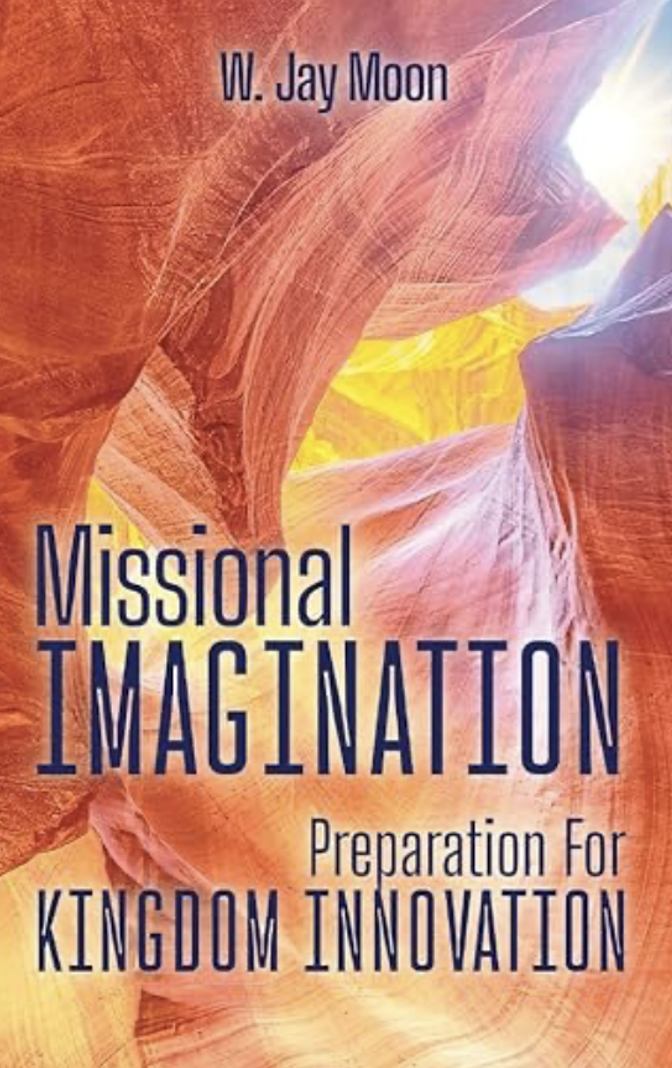
This is the burden behind my recently released book, Missional Imagination: Preparation for Kingdom Innovation.
This is not just another book on church growth, leadership strategy, or ministry techniques.
It is a call to recover something more foundational: the God-given capacity to sense the same realities as others, but envision entirely different possibilities to reveal the kingdom of heaven on earth.
Drawing from Scripture, history, and contemporary examples—from Matteo Ricci in China to modern church plants in Kentucky—the book explores how missional imagination is formed, what blocks it, and how it leads to real, tangible kingdom innovation. You can even learn your own MIQ (Missional Imagination Quotient) and how to increase this for kingdom innovation.
Why This Matters Right Now
We are living in a “Titanic moment.”
We have powerful tools (AI, digital platforms, global connectivity)
We have access to more knowledge than ever before
We are receiving signals about cultural change, declining engagement, and shifting worldviews
But the question remains:
Will we respond with imagination—or continue operating within sealed compartments?
Technology will not save us. Strategy alone will not sustain us.
Even theological precision, while essential, is not enough.
We need leaders who can imagine faithfully.
Forming a Different Kind of Leader
This book is written for:
Seminary students who sense that ministry in the future will require more than mastering existing models
Pastors who feel the tension between faithfulness and effectiveness in a changing culture
Missionaries navigating complex cultural landscapes where old approaches no longer connect
Mission leaders tasked with guiding organizations through uncertainty and transition
The aim is not to give you a formula.
It is to help you develop a way of seeing.
Because kingdom innovation does not start with brainstorming.
It starts with formation—spiritual, theological, and imaginative.
A Gentle Challenge
If the Titanic teaches us anything, it is this:
The greatest dangers are not always the ones we don’t see.
They are often the ones we see - but fail to interpret differently.
And if AI is right that we are now only limited by our imagination, then the stakes are even higher.
So here is the question:
What might God do through you if your imagination were fully aligned with His mission?
An Invitation
As this book released on May 20, 2026 on Amazon, I want to invite you into more than a reading experience.
I want to invite you into a journey:
To rethink how you see your context
To challenge assumptions you didn’t realize you were carrying
To experiment with new expressions of faithful ministry
To cultivate a missional imagination that leads to kingdom innovation
Because the future of the church will not be shaped by those who simply preserve what is.
It will be shaped by those who can imagine—faithfully, courageously, and creatively—what could be.
If that resonates with you, this book is for you.