Mission Conference at Arvada Covenant Church in Denver, Colorado, in September 2026. In the picture are Dr. Jay Moon, pastor Brian Rhen and Fabio Muniz.
We often hear that Christians are called to be the hands and feet of Jesus. Missionary Fabio Muniz recently asked, “What if we become the ears of Jesus?”
Listening may be one of the most overlooked practices in evangelism, church planting, and ministry leadership. We are often trained to explain the gospel, cast vision, teach Scripture, solve problems and give advice. Those are important skills. But sometimes the most missional thing we can do is close our mouths and open our ears.
God Is Already Having a Conversation
This assumption has transformed the way I think about evangelism:
God is already having a conversation with everyone you meet. Theologians sometimes describe this as prevenient grace — God is already at work in a person's life before we arrive.
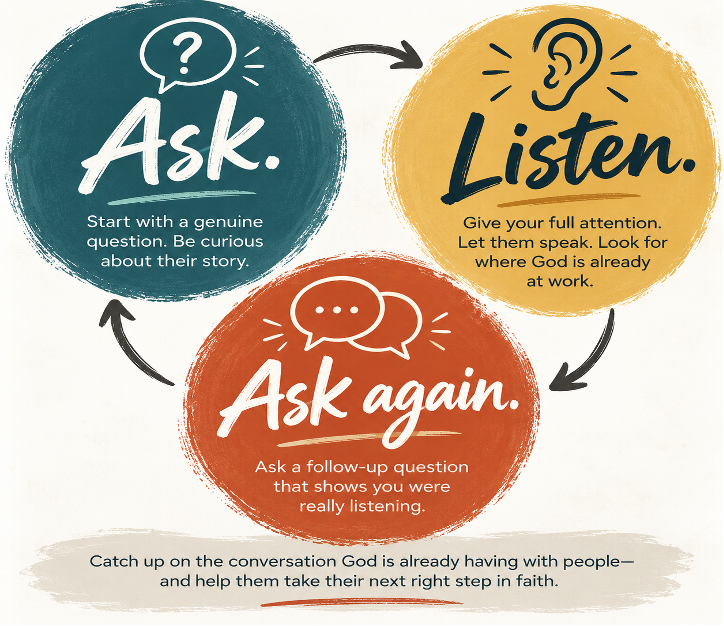
That changes the evangelist's job. We don't have to manufacture a spiritual conversation from nothing. Instead, we can learn to catch up on the conversation God is already having with someone and help keep that conversation moving toward Jesus.
That requires listening.
For church planters, this means listening carefully to the people and community God has called us to serve. For coaches, it means resisting the temptation to immediately provide an answer. For evangelists, it means becoming genuinely curious about the person sitting across from us.
Perhaps good mission begins with good ears.
God's First Question
Consider the first recorded conversation between God and humanity after sin enters the biblical story. Adam and Eve have eaten the forbidden fruit and are hiding.
God asks, “Where are you?”
That is a fascinating question for an omniscient God to ask. God didn't need Adam to provide GPS coordinates for the bush he was hiding behind. God already knew where Adam was. So why ask the question?
Because the question gave Adam an opportunity to speak AND an opportunity for God to listen as Adam articulates how he feels about what has happened.
Adam responds, “I was afraid — so I hid.”
The question moves the conversation beneath Adam's behavior to what is happening inside him.
Fear.
Hiding.
God dignifies Adam by asking a question - and then listening to the answer. If God begins this redemptive conversation with a question, perhaps those of us who want to help people move toward Jesus should pay attention.
Listening Can Be an Expression of Love
We sometimes assume evangelism begins when we start talking. What if it often begins when we start listening? Jesus repeatedly challenged people to have ears that truly hear. Listening communicates something powerful: You matter. Your story matters. I am interested in what is happening in your life.
And listening does something else: it helps us discover where God may already be at work. Instead of beginning with the question, “What do I want to tell this person?” we can begin by asking a different question, “What might God already be doing in this person's life?” That shift can completely change an evangelistic conversation.
The Best Date She Ever Had
I once taught a group of university students about listening. I gave some of the young men a simple challenge, “On your next date, ask the young lady a question. Then listen carefully enough to ask a follow-up question.”
They weren't convinced.
“It isn't that easy,” they told me. “We need to show her how good we are by talking - and maybe showing off a little.”
“Just try it,” I said. “Then tell me what happens.”
The next week, they reported back.
“How did it go?” I asked.
One young man shook his head.
“It was hard! I asked her a question, and she started talking. Then I asked a follow-up question - and she talked even more!”
“I didn't say it would be easy,” I replied. “How did she respond?”
A grin crossed his face.
“At the end of the night, she said it was the best date she had ever had!”
We laughed. But underneath the laughter was an important lesson: Opening our ears can open people's hearts.
A Different Approach to Evangelism
Imagine applying that lesson to evangelism. Instead of beginning with a memorized presentation, begin with curiosity.
Ask a meaningful question. Listen.
Then ask a question based on what the person actually said.
That second question is especially important because it demonstrates that you weren't simply waiting for your opportunity to speak. You were actually listening. The goal isn't to manipulate someone into a spiritual conversation. The goal is to understand the conversation God may already be having with them. Eventually, you may hear something about a fear, longing, disappointment, hope, relationship, dream or question that opens a natural pathway toward faith.
Now you aren't forcing Jesus into the conversation. You are discovering where the conversation may already be headed.
Church Planters Can Become the Ears of Jesus Too
This practice matters beyond one-on-one evangelism. Church planters can become so passionate about the church they envision that they fail to listen to the community where they are planting it. We arrive with answers before asking questions.
What if the first stage of church planting involved more listening? Walk through the neighborhood. Sit in coffee shops. Meet local leaders. Talk with teachers, business owners, parents, students, and people who don't attend church.
Ask questions such as:
What do you love about this community?
What makes life difficult here?
What do people worry about?
Where do people experience belonging?
Where do people turn when life falls apart?
What do you wish were different?
Then listen well enough to ask the next question. You may begin discovering the conversation God has been having with that community long before your church plant arrived.
Coaches Need Good Ears Too
The same principle applies to coaching. Good coaches know that giving someone the answer is not always the same thing as helping them grow. Often times the breakthrough comes through the right question. A question slows us down. It creates space for reflection. It helps people articulate something they may already sense but haven't yet put into words.
Then comes the difficult part: Don't immediately answer your own question.
Listen. And listen carefully enough to ask the next question.
Two Questions to Try
If you'd like to practice being the ears of Jesus, try asking someone you care about one of these questions:
“If you knew you couldn't fail, what step of faith would you take?”
Or:
“If you had a magic wand and could change your life over the next three to five years, what would it look like?”
Then resist the urge to tell your story. Don't immediately give advice. Don't start preparing your response while they're still speaking. Listen well enough to ask a follow-up question. You may be surprised by what you hear.
Opening Ears Opens Hearts
Being the hands and feet of Jesus matters. But perhaps we also need to recover the ministry of being the ears of Jesus. The church doesn't always need a better sales pitch. Church planters don't always need a more sophisticated strategy. Evangelists don't always need another presentation. Coaches don't always need another answer.
Sometimes we need to become better listeners. Since God is already at work in the lives of the people around us, our task isn't to manufacture His activity. It is to pay attention.
And as we catch up on the conversation God is already having with people, we may discover opportunities to help them take their next right step in faith.