Sweet Talk in Africa: Using Proverbs in Ministry
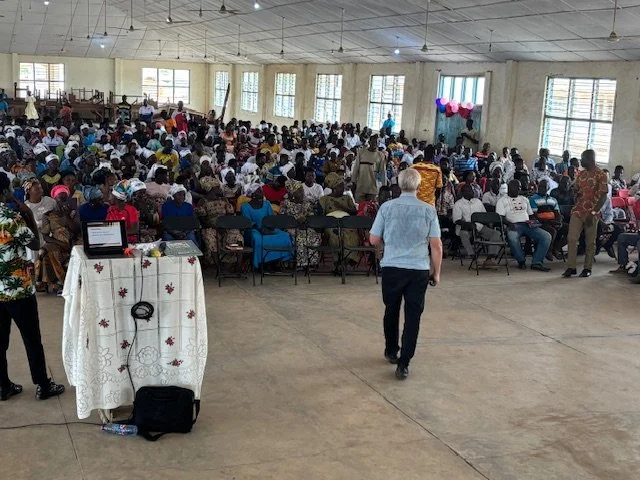
The audience roared with laughter.
Standing in front of over 800 people gathered for the Easter service in Fumbisi where we lived over 25 years ago, I was thinking about where to start the sermon. The following Builsa proverb came to mind, “Fi ma biik dan bo cham zuk, fi kan de tenka chianya” (If your relative is in the top of the sheanut tree, then you do not have to eat the sheanut fruit that has fallen to the ground). Immediately, the audience approved of the use of their own proverb to start a sermon. They listened with intense interest concerning was to come next. They all knew the meaning of the proverb – how was this to summarize the meaning of Easter?
I explained that the Builsa culture has used this proverb to describe the importance of having a relative in high places. If you know them well, then they can use their high position to help you. In that way, you will be given the choice fruit at the top of the tree and not simply left to eat the bruised or spoiled fruit dropped to the ground.
Easter reminds us that this is true for Christians. Jesus first came to earth in order to live among us and be one of us - like our relative. The resurrection, however, proves that he has risen to the top of the tree and is now seated at the right hand of our Father God. Since Jesus, our relative, is now at the top of the tree, we are sure that God hears us and will answer our prayers. We do not need to use the idols, sacrifices, talisman, black medicine, etc. ANY MORE – that is simply bruised fruit that has falled to the ground and is not needed since our relative provides the best fruit at the top of the tree.
Hands clap as smiling faces fill the room.
Three Reasons for Proverbs in Ministry
This reminded me again how important proverbs are for communicating the gospel in the Builsa culture. As a result, I am using the next three blog posts to share the following three reasons that traditional proverbs should be incorporated into ministry in Africa:
1. PROVERBS OPEN EARS TO HEAR THE GOSPEL
2. PROVERBS CLEAR AWAY THE FOG IN THEOLOGICAL COMMUNICATION
3. PROVERBS ROOT THE GOSPEL IN VERNACULAR SOIL
My Own Journey:
This is not simply theoretical. When I first began to learn the Builsa proverbs, not only did my language learning improve (and become more enjoyable), but also the strange culture in which I was living gradually became less strange. I noticed recurring themes that emerged from the proverbs and these values helped me to make sense of the culture I was struggling to understand (Moon 2002). Gradually I was learning that the proverbs were an open window into the Builsa’s deep cultural values. The more I understood these, the better I was able to understand and communicate in this culture.
I also noticed how the Builsa began to appreciate my interest in their proverbs. They were very proud of their proverbs since they were fully Builsa and were the “deep talk” that the elders prized. I observed how the Builsa appreciated proverbs when speaking among themselves, but they appeared to enjoy it doubly when an outsider was speaking proverbs to them. It seemed that the sweet talk had become extra sweet. My interest in their proverbs communicated to them that I respected and valued their cultural heritage. Nussbaum (2002) stated, “Showing courtesy and respect is one of the clearest demonstrations of love that a missionary can give.”
I found that the Builsa responded very warmly when I demonstrated my love in this way.
Teaching in Class
When I was teaching a class on church planting at the Bible training center in northern Ghana, I often asked the class to summarize the stage of church planting that we were discussing by using one of their proverbs. This reversed the flow of communication and power since I (the teacher) was now the struggling learner. I was amazed at the response.
The students began to see that theology dealt with issues of their own culture, and it could be expressed in terms and concepts that were highly valued in their culture. As they began to explain the proverbs to me, I was again humbled to learn from them. The excitement in the classroom increased as we all enjoyed the proverbs and their applications.
When discussing the need for small groups, some proverbs given were: “If you put plenty [too much] in the mouth, you can’t chew it all,” and “A small fire burns all of the bush [unprepared field].” One student related the importance of public commitment (baptism, etc.) to the proverb: “If you have your new clothing and do not wear it [out in the open for others to see], then no one will know that you have it.” As I listened to these proverbs and their explanations, I observed how they were expressing God’s truths in an artistic manner that clearly and concisely communicated deeply within their own soil. In the process, I gradually felt my own ears open, and my relationship with the students deepened.
Join me in the next three blog posts as we discuss “Sweet Talk in Africa, Using Proverbs in Ministry.” I am sure it will provoke new thoughts related to culture and the Bible.
This blog is slightly revised from the original article printed in 2004 by W. Jay Moon "Sweet Talk in Africa: Using Proverbs in Ministry." Evangelical Missions Quarterly 40(2):162-169. See: http://www.emisdirect.com/emq/issue-125/422