Sweet Talk: How Proverbs Clear the Fog of Theological Communication
“Proverbs are the palm oil with which words are eaten,”Chinua Achebe, Things Fall Apart
As a new missionary living among the Builsa people in a rural village in Ghana, West Africa, my goal was to learn the language. I also wrestled with understanding a culture that was vastly different from the American suburban culture with which I was familiar. I often observed the Builsa people engaging in lively, entertaining and seemingly effective forms of communication. They were using traditional proverbs, which made the conversation “sweet,” meaning pleasant to listen to and easier to digest or understand. I wondered, “Could this be an effective vehicle for communicating the gospel in a way that was sweet to the listeners’ ears and also sweet to their hearts?” After ten years of exploring this question, I suggest three reasons that missionaries (both expatriates and nationals) in predominantly oral cultures should actively incorporate the use of traditional proverbs in their ministry: 1) proverbs open ears to hear the gospel; 2) proverbs clear away the fog in theological communication; 3) proverbs root the gospel in vernacular soil.
Proverbs Clear the Fog of Theological Communication
Have you ever stood before an audience and observed a person’s eyes glaze as if his or her mind has fogged over just as you reached what you thought was the climax of a crucial theological truth? Proverbs are often useful for clearing away the fog since they make communication clear and concise. A short proverb can speak volumes by using metaphors and values with which the people readily identify.
When the Builsa were asked why they use proverbs, almost one third responded that proverbs were useful to clarify a situation or a conversation, or to give quick meaning (Moon 2000). When asked “What would someone sound like if they did not use proverbs?” their most common responses were that people would not understand well, the communication would not be sweet, or people would not listen to them. It would sound odd, childish, untrue or irrelevant. According to one man, a person who does not use proverbs in serious conversation “is speaking in the rain.” If you have ever tried to listen to someone while raindrops, like the steady clashing of a cymbal, resounded from a metal roof, then you will understand this African’s frustration at listening to a lengthy speaker who didn’t use proverbs. A Yoruba proverb states, “Proverbs are the horses of speech; if communication is lost, we use proverbs to find it” (Lindfors 1973).
A short-term missionary was visiting the Builsa area and I served as his translator. He was introducing a new agricultural technique that the people seemed to like. He eventually tried to explain that the equipment would be sold to them (at a subsidized price) since he found that people who invested their own money in something tended to value the item more, use and maintain it. The audience did not understand the concept that he was trying to convey despite several attempts to do so. Finally, I told them the proverb, “Fi dan pisi wiik gauta po, ku le be gauta po” (If you find a whistle while dancing, then it will get lost again while dancing). Immediately, the audience erupted in laughter and the people understood the missionary’s meaning since the proverb’s meaning was clear—if you just find (or are given) something without any effort on your part, you will not take care of it and it will easily get lost. No more needed to be said to the group. In just a few words, the fog lifted and the meaning was clearly and concisely communicated.
Proverbs can also serve as effective vehicles to clarify theological truths. Since no one typically doubts the validity of a proverb, the truths they contain can often be helpful in conveying biblical truths in a manner the people can understand and value as their own. In this light, proverbs can be seen as a gold mine that God has placed in the culture. Believers need to discover them, extract the gold contained therein, and use them in a manner that glorifies God.
After I used some proverbs to clarify a biblical teaching, a Builsa responded, “I know that God’s word is not just words from the white man but is God’s word for the Builsa since our own proverbs confirm it.” Once the proverbs were tapped, the gospel was clarified for this man so that it became God’s good news for Africans—a treasure deep within African soil.
This blog is slightly revised from the original article printed in 2004 by W. Jay Moon "Sweet Talk in Africa: Using Proverbs in Ministry." Evangelical Missions Quarterly 40(2):162-169. See: http://www.emisdirect.com/emq/issue-125/422
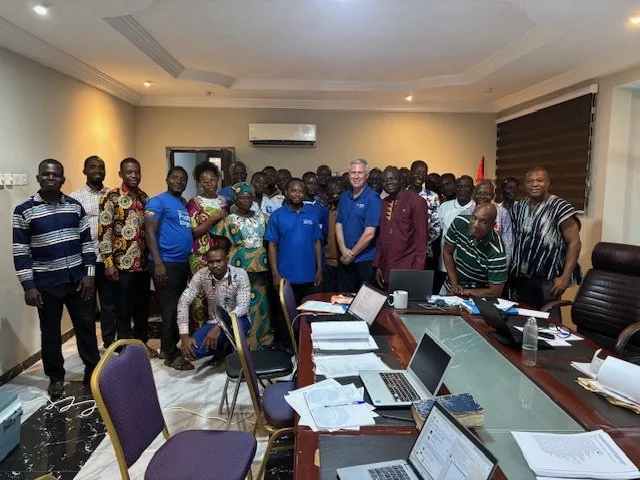
Dr. Jay Moon with the GNBC Ghana leadership board